

Helping Babies and Toddlers Sleep on Airplanes (The Part Most Advice Misses)
Practical tips for helping babies and toddlers sleep on airplanes, based on real experience from 20+ long-haul flights with young kids.
One of the most common questions parents ask before a long flight with a baby, toddler or even preschool-aged kid is simple: how do I get my child to sleep on the plane?
If they sleep, the whole flight suddenly feels manageable. But many parents discover that even when their child finally falls asleep after rocking, shushing, patting and (in some cases) bribing, keeping them asleep becomes the biggest challenge. If you’ve ever flown with a baby or toddler, you might recognize this moment. You finally get them settled. Their eyes close. You take a deep breath for the first time in an hour.
Then ten minutes later the cabin lights flick on, the drink cart rolls by, someone squeezes past your row — and suddenly your child is awake again.
Now you're starting over.
After enough long flights with our own kids, we realized we’d been asking the wrong question all along: the hardest part wasn’t getting them to fall asleep. It was protecting their sleep once it started.
THE ADVICE MOST PARENTS HEAR
When parents start looking for ways to make flights easier with their little ones, most of the advice focuses on comfort. Bring a travel pillow. Pack their favorite blanket. Use a seat extender so they can stretch out. Bring familiar toys or books to help them settle down.
All of these things can help children relax, get comfortable and cue sleep, which certainly matters on a long flight.
But many parents discover that with everything going on around them, it can be hard for their child to even settle down in the first place. And if they do finally fall asleep, the sleep doesn’t always last very long. A neighbor switches on their personal TV screen or turns on their seat light to read a book. The cabin lights turn on for meal service. Movement and activity around the seat change every few minutes.
Through trial and error we started noticing a pattern. Even when our kids were tired and comfortable, the activity and movement around them kept interrupting their ability to sleep.
HOW SLEEP CUES AFFECT YOUNG CHILDREN
When babies and toddlers sleep at home, most parents instinctively create a calmer environment by dimming the lights, reducing distractions, and signaling that it’s time to rest.
Airplanes, however, are almost the opposite of that environment. They’re one of the most stimulating and unpredictable places a young child can try to sleep.
Children find themselves in very close proximity to new sounds, movement, and activity, and all of that stimulation makes it harder to settle, and easier for them to wake up again soon after. We would often hold our breath any time something would move or change around our little ones, hoping and praying they would stay asleep.
Parents have the seemingly impossible challenge of trying to recreate a calmer sleep environment, as close as possible to what their children would experience at home, in a place that is naturally highly stimulating.
WHY SLEEP ENVIRONMENTS MATTER
Sleep researchers often talk about sleep cues, which are signals in the environment that tell the brain it’s time to rest.
Darkness is one of the strongest cues. When lights dim and activity slows down, the brain begins releasing hormones that support sleep and help the body settle and stay asleep longer.
That’s why many parents know to darken a room or close the door before putting a baby or toddler down for the night. The environment itself becomes part of the signal that it’s time to sleep.
When those cues suddenly change, like when bright lights turn on in the middle of a flight or movement around the seat increases, the brain can shift toward wakefulness.
For young children especially, even small changes in their surroundings can interrupt sleep or make it really difficult to settle.
WHAT FINALLY HELPED US ON OUR FLIGHTS
Once we shifted our perspective on what truly makes a difference, we stopped focusing only on comfort and began paying much more attention to the space around them.
The flights that went best weren’t necessarily the ones where we had the perfect seat extender, pillow or toy. They were the ones where we were able to recreate a darker, quieter sleep environment, closer to the one they were familiar with from their day-to-day.
Sometimes that meant turning off the seat screen nearby, tucking them by the window seat to be further away from the distractions of the aisle, or fumbling with a blanket tucked into the tray table to create a “nook” to block light from the aisle as much as we could. Even small changes seemed to matter.
When the space around them became calmer, our kids were often able to settle more easily — and once they fell asleep, they were much less likely to wake up from the hustle and bustle of a busy airplane.
WHAT THIS LED US TO BUILD
That’s when we started wondering why most travel gear focused only on making the seat more comfortable, but almost nothing addressed the sleep environment itself as the real cause for poor sleep onboard.
We even thought about using something like an eye mask to block out light. In theory, it makes sense — but in practice, most young children find it uncomfortable or distracting, and it often ends up becoming one more thing to manage instead of something that helps.
We kept coming back to the same idea: what if you could reduce the stimulation around them without putting anything on them at all?
That question eventually led us to create NapNest — a lightweight blackout nook designed to sit on an airplane seat and help shield children from visual distraction around them during a flight.
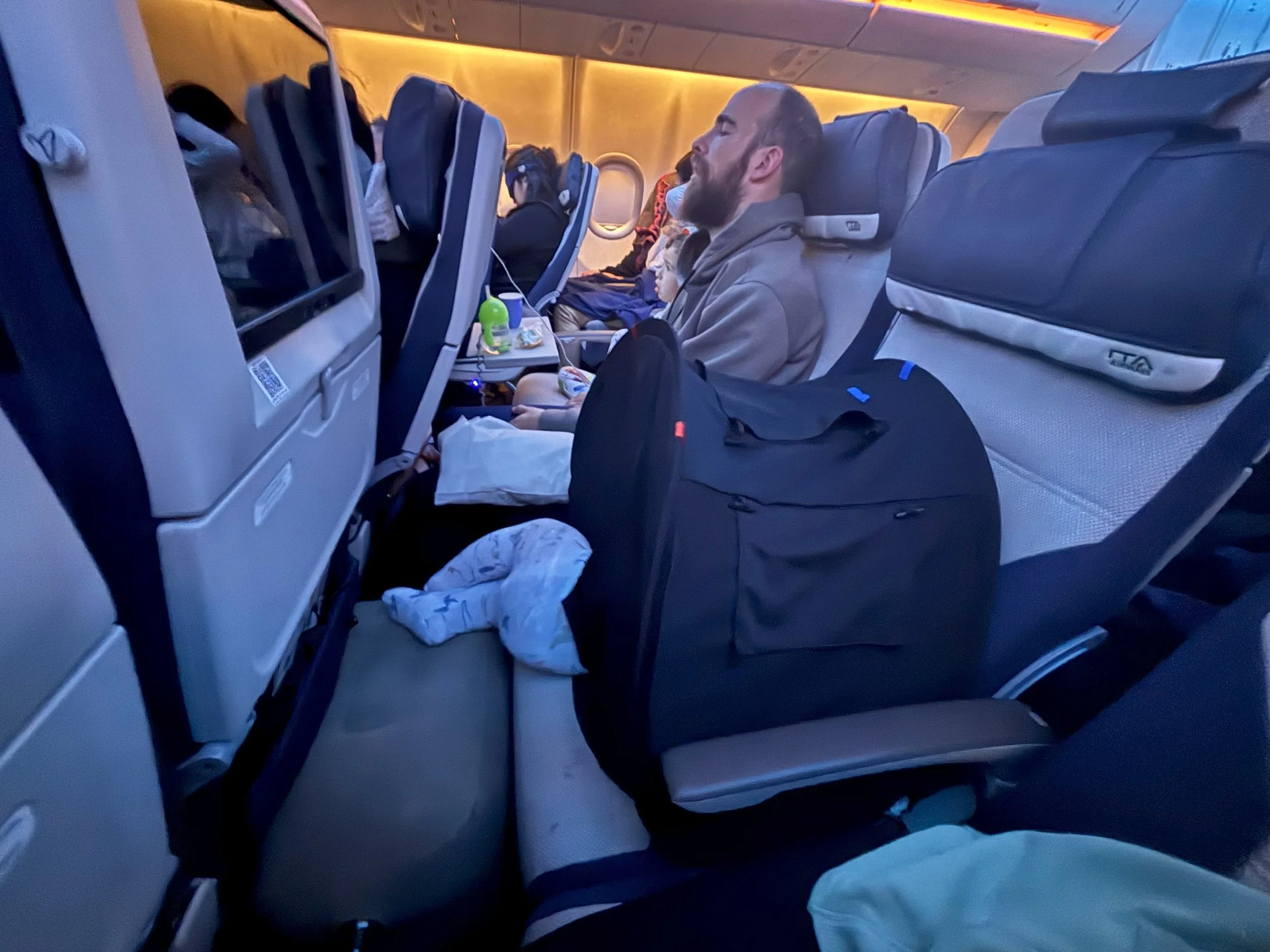
NapNest in use on a flight
By blocking out light and activity around the seat, it helps recreate the sleep cues children rely on at home signaling it’s time to rest. It doesn’t replace what helps your child fall asleep, but it’s designed to help them stay asleep longer and more deeply.
IT WON’T BE PERFECT, BUT IT CAN BE EASIER
Let’s be real: traveling with babies and young kids will never be perfectly predictable. We’ve been on countless domestic flights and 20+ international flights with our littles and learn something new every time. There will still be moments that don’t go as planned, and some flights will be easier than others.
Still, understanding the role of the sleep environment can make flights feel much more manageable, for both kids and parents. Instead of focusing only on getting your child comfortable, small shifts to tune out the chaos around them can help create the right conditions where they’re more likely to settle and stay asleep.
And when your child is able to rest, even for a little while, the whole family enjoys a happier, smoother travel experience.
You might even finally finish that book you started 6 months ago!
Be among the first families to get access to patent-pending NapNest.
If you're preparing for a flight with a baby or toddler, you will also receive short guide with the practical things that helped us most.